Education

Submit Blog & RSS Feeds

Money Grows Tree

Friday, 14 October 2016

45 Tips To Live a Healthier Life

45 Tips To Live a Healthier Life

Salad
How healthy are you? Do you have a healthy diet? Do you exercise regularly? Do you drink at least 8 glasses of water a day? Do you get enough sleep every day?
Our body is our temple, and we need to take care of it to have a healthy life. Do you know that a shocking over 65% of Americans are either obese or overweight? That’s insane! Think of your body as your physical shell to take you through life. If you repeatedly abuse it with unhealthy food, your shell will wear out quickly. While you may look okay on the outside, on the inside, your arteries are getting clogged up with cholesterol and arterial plaque. That’s not a pretty sight!
Life is beautiful and you don’t want to bog yourself down with unnecessary health problems. Today, your vital organs (kidney, heart, lungs, gall bladder, liver, stomach, intestines, etc) may be working well, but they may not be tomorrow. Don’t take your good health today for granted. Take proper care of your body.
Good health isn’t just about healthy eating and exercise – it also includes having a positive mental health, healthy self-image and a healthy lifestyle. In this article, I’ll share with you 45 tips to live a healthier life. Bookmark this article and save the tips, because they are going to be vital in living a healthier life.
  1. Drink more water. Most of us actually don’t drink enough water every day. Water is essential for our body to function – Do you know over 60% of our body is made up of water? Water is needed to carry out our body functions, remove waste and carry nutrients and oxygen around our body. Since we lose water every day through urine, bowel movements, perspiration and breathing, we need to replenish our water intake.
    Water
    Furthermore, drinking more water alone actually aids in losing weight. A Health.com study carried out among overweight/obese people showed that water drinkers lose 4.5 more pounds than a control group. The researchers believe that it’s because drinking more water helps fill your stomach, making you less hungry and less likely to overeat. I agree with that, and I have an added take that your body tries to retain whatever water you take when you don’t take in enough water, leading to increase in weight. Whereas when you regularly drink water, your body knows that it’s going to get its supply of fluids, so it doesn’t try to retain more water.
    The amount of water we need is dependent on various factors such as the humidity, our physical activity, and your weight, but generally we need 2.7-3.7 litres of water intake! Since food intake contributes about 20% of our fluid intake, that means we need to drink about 2.0-3.0 litres of water, or about 8-10 glasses (now you know how the 8 glasses recommendation came about!). One way to tell if you’re hydrated – your urine should be colorless or slightly yellow. If it’s not, you’re not getting enough water! Other signs include: Dry lips, dry mouth and little urination. Go get some water first before you continue this article!
  2. Get enough sleep. When you don’t rest well, you compensate by eating more. Usually it’s junk food. Get enough rest and you don’t need to snack to stay awake. Also, lack of sleep causes premature aging, and you wouldn’t want that.
  3. Meditate. Meditation quietens your mind and calms your soul. If you don’t know how to meditate, don’t worry – learn how to meditate in 5 simple steps.
    Meditation at the field
  4. Exercise. Not just a few times a week, but every day. Movement is life. Research has shown that exercising daily brings tremendous benefits to our health, including increase of life span, lowering of risk of diseases, higher bone density and weight loss. Increase activity in your life. Choose walking over transport for close distances. Climb the stairs instead of taking the lift. Join some aerobics classes. Take up a sport of your liking (see tip #5)
  5. Pick exercises you enjoy. When you enjoy the sports, you’ll naturally want to do them. Exercise isn’t about suffering and pushing yourself; it’s about being healthy and having fun at the same time. Adding variation in your exercises will keep them interesting.
  6. Work out different parts of your body. Don’t just do cardio exercises (such as jogging). Give your full body a proper work out. The easiest way is to engage in sports, since they work out different muscle groups. Popular sports include basketball, football, swimming, tennis, squash, badminton, frisbee, and more.
  7. Eat more fruits. Fruits are a plethora of vitamins and minerals. Do you know that oranges offer more health benefits than Vitamin C pills? Taking in synthetic supplements are not the same as consuming the foods direct from nature. Fill your palate with these nutritious fruits: Watermelon, Apricots, Avocado, Apple, Cantaloupe, Grapefruit, Kiwi, Guava, Papaya, Strawberries.
    Fruits
  8. Eat more vegetables. Like fruits, vegetables are important for the well being of our health. Experts suggest that we should have 5-9 servings of fruits/vegetables, and unfortunately most people don’t even have at least 5 servings! Some of my favorite vegetables include: Kidney beans, black beans, asparagus, long beans, french beans, sprouts, button mushrooms and carrots. What are your favorite vegetables and how can you include more of them in your diet today?
  9. Pick bright colored foods. Fruits and vegetables with bright colors are usually high in anti-oxidants. Anti-oxidants are good for health because they remove free radicals in our body that damage our cells. So get your fill of fruits/vegetables of different colors: White (Bananas, Mushroom), Yellow (Pineapples, Mango), Orange (Orange, Papaya), Red (Apple, Strawberries, Tomatoes, Watermelon), Green (Guava, Avocados,  Cucumber, Lettuce, Celery), Purple/Blue (Blackberries, Eggplant, Prunes). Here’s a full list under the color wheel.
  10. Cut down on processed food. Processed foods are not good because (1) most nutritional value is lost (2) the preservatives added are bad for our health.  Many processed foods contain a high amount of salt content, which leads to higher blood pressure and heart disease. Processed foods are anything that are not in their raw form. In general, most of the food in supermarket are processed – the more the ingredients on the label (especially the ones ending with ‘ite’ or ‘ate’), the more processed they are. Watch out for those with salt/sugar as the first 5 ingredients and go for natural foods as much as possible.
  11. Love yourself. How much do you love yourself on a scale of 1-10? Why? How can you love yourself more starting today? In Day 20 of 30DLBL, we explore the notion of self-love and get you started on loving yourself more.
    Pink hearts
  12. Barefoot walking/running. There have been many proven positive benefits of barefoot walking/running, from better posture, less stress for your feet, less stress for your joints, etc . I’ve been running barefoot since May ’10, and loving it. Read more: 10 Reasons To Run Barefoot
  13. Purge negative people from your life. Positive mental healthy is an important part of a healthy life. You don’t need toxic people in your life. If you feel that a friend is overly critical or negative, then let him/her go.
  14. Purge negativity from yourself. You don’t need negativity from yourself either. Listen in on the thoughts that come up in your mind and get rid of the negative thoughts you hear. A lot of eating happens because one feels unhappy, so by staying in a positive, up state by yourself, you cut out that unhealthy dependence on food to be happy.
  15. Journal out unhappy thoughts. One great way to purge negativity from within is to do brain dumping exercises whenever you feel frustrated. This is something I do with my 1-1 clients as well, where I ask them to journal out their deepest thoughts so we can address them. Don’t keep these thoughts pent up inside of you – it’s not healthy.
  16. Avoid trigger foods. Trigger foods are the foods that make you go berserk and binge like crazy after you eat them. Everyone’s trigger foods are different (mine are donuts, pastries, pasta and chips), but generally trigger foods are candy bars, chocolate, confectionery, chips, cookies, or anything with high level of refined sugar, salt, fat or flour. These foods cause a blood sugar imbalance, hence triggering one to eat more. What are your trigger foods? Identify them and remove them from your diet.
  17. Breathe. Deeply. Oxygen is a vital source of life. You may know how to breathe, but are you breathing properly? Most of us don’t breathe properly – we take only shallow breathes and breathe to 1/3 of our lung capacity. Athletes are coached proper breathing techniques to get their best performance. A full breathis one where your lungs are completely filled, your abdomen expands and there’s minimum movement in your shoulders.
    Woman breathing
  18. Address emotional eating issues. Emotional eating is eating to fill an emotion, rather than real hunger. Do you eat when you feel stressed out, down or frustrated? Do you reach out for food when you hit a block at work? Chances are, you’re emotional eating. However, emotional eating will never make you feel happy, because you’re trying to fill a void that has nothing to do with food. Food doesn’t give you love or happiness; it’s just food. Why do you reach out for food when you’re down? How can you address it? Get to the root of the issue and address it. Read: How to Stop Emotional Eating (6-part series)
  19. Eat small meals. Choose several small meals over a few big meals a day. This balances out your energy distribution throughout the day. In general, eat when you feel hungry, and stop when you’re full (see tip #20). You don’t need to wait until official meal times before you start eating. Listen to your body and what it tells you.
  20. Stop eating when you feel full. Many of us rely on external cues to tell when we’re full, such as whether everyone has finished eating, whether your plate was empty or not. These are irrelevant – you should look at internal cues, such as whether your stomach feels full or not. Don’t feel obligated to eat just because there’s still food at the plate. Personally I like to stop when I feel about 3/4 full – if I eat till I’m totally full, I feel uncomfortable as my digestive system goes into overdrive. Use your gut as your indicator (literally).
  21. Go for brown carbs vs. white carbs. White carbs are refined grains like white rice, pasta, white bread, crackers, noodles, tortillas, wraps, anything with white flour and breading. The nutrients have been removed in the production process, leaving them rich in calories but low in nutrients. They also cause unhealthy spikes in our sugar levels. Go for brown carbs (unrefined complex carbs) instead, like brown rice, whole grain, oats, oatmeal, legumes, nuts. These come with nutrients and vitamins intact.
    Legumes
  22. Live a life with purpose. Positive health starts from within! Are you living a life of meaning? Are you living in line with your purpose? After I started living in line with my purpose 2 years ago, I’ve never ever been happier. And you can experience that too. Read: Discover Your Purpose in Life (series)
  23. Say no to oily food. Reduce your intake of fast food, fries, doughnuts, chips, wedges, and foods that have been deep fried. Not only are they very fattening (1 tablespoon of oil is 120 calories), deep fried food contains acrylamide, a potential cancer-causing chemical. According to a BBC report, an ordinary bag of crisps may contain up to 500 times more of the substance than the top level allowed in drinking water by the World Health Organisation (WHO). I personally find that when I consume oily foods, I feel sluggish. There are better alternatives, such as grilled, steamed, stir-fried or even raw food (see tip #41).
  24. Cut out sugary foods. These are your candy bars, your pastries, chocolate, cookies, cakes and jelly donuts. Not only do they not fill you, they trigger you to eat more due to the sugar rush they cause (see tip #16). Go for healthy snacks instead (see tip #36) – you’ll be more satisfied and happy.
  25. Go organic. Organic foods are foods produced without “synthetic inputs such as pesticides and chemical fertilizers, do not contain genetically modified organisms, and are not processed using irradiation, industrial solvents, or chemical food additives”. (Wiki) The organic movement is slowly catching on, with more supermarkets, especially in US, offering organic options. Organic food tends to cost more, but hey – would you rather save some money and feed your body with pesticides or pay a few extra dollars for a cleaner, healthier body?
  26. Improve your posture. Good posture improves your breathing (see tip #18) and makes you look more smarter and more attractive. Read more: Benefits Of Having A Good Posture (And 13 Tips To Get One)
  27. Cut out soda and caffeine. Drinks with caffeine are diuretics – meaning they speed up the rate of urine production. Hence, these drinks do not contribute to your 8 glasses of water/day requirement – they actually take away from it! Furthermore, soda is unhealthy, causes weight gain, is an artificial stimulant, among other reasons. Ditch your soda and go for plain water or fresh fruit juices instead! Read more: 5 Reasons To Quit Soda (And How to Do It)
    Soda Drinks
  28. Don’t drink alcohol. Like caffeine, alcohol is a diuretic. Not only that, alcohol is repeatedly proven to have negative effects on our body and health – impacting the proper functioning of our brain, liver, lungs, and other major organs. If you drink alcohol regularly, it’s time to cut it out.
  29. Prepare your meals. Lately I’m beginning to appreciate the value of preparing my own meals. When you prepare your meals, you control what goes into them. No more being in a dilemma between eating healthy  and choosing between the sub-optimal food choices. Get some quality kitchen equipment – these will be your best investments ever. I bought my blender 3 years ago and it’s been such a breeze making my own fruit juices!
    Home prepared meal
  30. Learn to say no. Don’t feel like you’ve to eat just because you’re out with your friends, or because other people offer you food. Simply say no and say you’re not hungry if you don’t feel like eating. Read: How to Say No To Others
  31. Bring a water bottle when you go out. That way, you can replenish your fluids whenever you want to. It saves you money as well and you don’t need to subject yourself to poor alternatives like soda, which increases your fluid outtake instead (see tip #27).
  32. Dine at salad bars more often. Lately I’m falling in love with salad bars. Salad bars work like this: You pick your greens, you select X number of toppings (usually 6 or limited, depending on the outlet) and you finish off with a dressing. The variety is huge, it’s filling and it’s extremely healthy.
    Salad bar
  33. Go for low calorie, low fat alternatives. There are many low-fat / non-fat alternatives today – from yogurts, to salad dressing, soy milk, spreads, ice cream, etc. Check out this comprehensive list: Lower Calorie, Lower Fat Alternatives.
  34. Stop smoking. It has been extensively proven that smoking is detrimental to health,  severely increasing the risk of lung cancer, kidney cancer, esophageal cancer (of our gullet), heart attack, and more. Smoking “light” cigarettes does not decrease health risks. Bottom line – if you’re a smoker, quit for better health of not just yourself, but also your family and friends. If you don’t smoke, stay that way and don’t start.
  35. Avoid passive smoking. Second hand smoking (breathing in air from smokers) causes many of the same long-term diseases as direct smoking (Wiki). Get away from smokers and avoid cigarette smoke where you can.
  36. Have healthy snacks. If you’re hungry during work, eat healthy snacks, like fruits, salads, and fruit juices. These are nutritional and don’t give you that sugar rush. Have them readily available so you can dive in for a munch and stop when you’d had your fill. Get away from cookies and candy bars.
    Fruits
  37. Drink fruit/veg smoothies. I love smoothies because it’s a quick way to get vitamins and nutrients. Simply throw my favorite fruits into the blender, wait for 30 seconds, and it’s done! And it tastes great. I’m drinking an orange and banana smoothie write now as I’m writing this article and it’s delicious!
  38. Juicing. Juicing is where you extract the juice from vegetables / fruits (via a juicer machine). Since the fibre is stripped away, you are literally drinking the nutrients and minerals directly from the juice! Juices and smoothies complement each other – the former gives our digestive system a break while the latter gives us the fibre which aids our digestion. Check out an introduction to juicing video below. If you’re new to juicing, learn more about it here and check out these sample juicing recipes.
  39. Go on a vegetarian diet. First off, going vegetarian doesn’t necessarily lead to better health, because there are many unhealthy vegetarian food out there (fried food, white carb laden diets, etc). On that note, there are many proven health benefits of a vegetarian diet. I became a vegetarian because I tried it for 30 days and saw the positive effects for my mental and physical health. Try it out for 21 days and see how it works out for you. Get started here.
  40. Go on a vegan diet. A vegetarian is someone who does not consume animal products. A vegan is someone who doesn’t consume animal or animal-derived products. This means no dairy, honey, cheese, milk, etc. So in that sense, it’s seemingly stricter, but it brings about even more positive benefits on top of a vegetarian diet. Learn more about veganism here and here.
    Salad
  41. Become a raw vegan. A raw vegan consumes only non-processed, raw vegan food, mainly fruits, vegetables and nuts. Notice that the progression from vegetarian -> vegan -> raw vegan diet is toward foods that are naturally occurring. There are many reported benefits in switching from veganism to raw veganism, including increased youth, weight loss, increased energy, increased health benefits and more. It’s an area that I’m exploring at the moment and learning more of. Learn more about raw veganism: Here, here, here and here.
  42. Get out more often. If you have a regular 9-5 job, chances are you spend most of your times holed up in the office and not a lot of time going out and having fun. During weekends, you’re probably busy with work or running errands. Make it a point to go out with friends at least once a week. Get some sunlight. Go out and have a change in environment. It’ll be great for your body and your soul.
  43. Exercise good dental hygiene. Not only does good hygiene make you a lot more desirable, it is linked with better health. Brush your teeth twice a day, rinse your mouth after each meal and floss your teeth at night. Read: How to Attain Healthier Gums and Teeth: Path To Better Oral Hygiene
    Woman brushing teeth
  44. Join classes. Dance classes, aerobics classes, tennis classes, ballroom dancing, scuba diving, wake boarding courses, are all places to start off with. Going there also lets you socialize with a whole new group of people.
  45. Hang out with healthy people. You’re the average of the 5 people you spend the most time with, so the more time you spend around healthy people, the better it is. Eat with people who are health conscious and get workout buddies. It makes healthy living even more fun.

Wednesday, 12 October 2016

Nicki Minaj Says She Can Do Anything Jay Z Can Do and Instantly Reminds Us Why She's a Boss


Nicki Minaj, Marie Claire
Kai Z Feng
Nicki Minaj has made it a point to come into the scene and shake things up.
Whether it's making room for more female emcees in a male-dominated industry or proving that there is no glass ceiling she can't break, Barbz has used her celebrity to be (very) vocal about what she believes in and has therefore become the poster image for a boss, because one thing's for sure—whatever Nicki wants, she's gonna make sure she gets it.
Posing with fierce realness on the cover of Marie Claire for their latest issue, the rapper touches on women's goals and competing with big-time male rappers by explaining that she can most definitely create a career and empire for herself, just like any of the big boys. Even Hov.
Nicki Minaj, Marie Claire
Kai Z Feng
 "I don't need to read a book about [business]. I can look at someone's career and just pinpoint the dos and the don'ts, and the one person I've done that with for my entire career was Jay Z," she says.
"He did such a great job being an authentic street guy and a businessman, and I was like, Why aren't there women doing that, taking the success from rap and channeling it into their empire? I felt like anything he could do, I could do."
Minaj touched on the fact that many women seem to marry into money these days instead of creating a fortune for themselves, which she finds worrisome. "Nowadays, I feel like [young women] see marrying into money—I think that's a big thing now. I don't want that to be a woman's goal in life," she states.
Nicki Minaj, Marie Claire
Kai Z Feng
"I want your goal in life to be to become an entrepreneur, a rich woman, a career-driven woman.  You have to be able to know that you need no man on this planet at all, period, and he should feel that, because when a man feels that you need him, he acts differently."
Another woman who breeds the same message of female empowerment is Nicki's gal-pal, and Jay's wife, Beyoncé The two artists have collaborated on "Feeling Myself" and the "Flawless (Remix)," both of which quickly became anthems for women who enjoyed acknowledging their independence while bobbing to a catchy beat.
Nicki completely understands the draw to her projects with Queen B, and it has everything to do with what these two represent.
"Every time Bey and I do something together, I see how women are inspired, and it has nothing to do with how we look. It has to do with how we are owning who we are and telling other women you should be the boss of your own career and the brains behind your life or your decisions or your art. I just love that feeling."
For more of Nicki Minaj's interview with Marie Claire, pick up their November issue when it hits newsstands on Oct. 18.

RIP to Our Favorite Scream Queens Character


Color us truly and completely devastated.
We had a feeling the wedding of Chanel Oberlin (Emma Roberts) and Chad Radwell (Glen Powell) wasn't going to end well, but we definitely didn't imagine it would end that badly, with Chad's dead body falling through the ceiling of the hospital chapel.
Sure, Chad was an awful idiot with no limit to how offensive and horrible he could be, and our love for him was complicated at best, but we couldn't help delighting in his beautiful face and love for all his dead frat bros.
We're also upset about his death because it kind of seems as if Dr. Brock (John Stamos) killed him, and if you can't trust John Stamos, who can you trust?! 
Let's go back a bit.
Chad was completely convinced that Brock was a serial killer, thanks to the fact that he had the hand of a serial killer. Chad's big plan to fix this was to find a new hand donor for Brock, and swap out his murdery hand for a less murdery hand.
Chad was even willing to perform the hand transplant surgery himself, despite literally any other decision probably being a better one.
In the meantime, he and Brock continued their competition for Chanel. At first, she chose herself, but then Chad wrote up a pre-nup and proposed to her with the help of a mariachi band, and they decided to get married the next day. Zayday (Keke Palmer) and Number 3 (Billie Lourd) were bridesmaids, Number 5 (Abigail Breslin) was the doggy ring bearer, and Chad had even asked Brock to be his best man, since all Chad's bros were missing or dead. 
Chad just really needed someone to keep him from straying from his new bride, since Chad is wont to do those sorts of things, and he actually really kinda loved Chanel, and Brock agreed. So maybe he just took his duties a little too far?
We'll probably find out soon. 
Scream Queens, Emma Roberts, John Stamos
Fox
Elsewhere, Cheri Oteri played a patient with a disorder that gave her constant uncontrollable orgasms. In the process of curing her (which they did), Cassidy and Number 3 bonded. He revealed that he's dead (he once choked on vomit and is now roaming the earth searching for a purpose), and she revealed that she has never had an orgasm.
Cassidy then realized that giving Number 3 an orgasm must be his purpose, but she was never quite in the mood. She was also kinda struggling with his cold dead skin, which he proved was truly cold by revealing his temperature to be 61 degrees.
Unfortunately for Cheri Oteri, she did not make it out of the hospital alive. As she was leaving, the Green Meanie sliced off her head, but ran away from Zayday, which is very curious. 
And in Hester (Lea Michele) news, she's finally made the move over to the Cure Institute. She's living in the basement, rocking that Hannibal Lecter mask, and occasionally handing out helpful leads in figuring out who the serial killer is. Unfortunately, it's just not enough to keep all the patients from dying.
The only real clue we got tonight came from a lotion mogul, who worked for the hospital during the Halloween party of 1986. He said that he's been getting phone calls from someone who knows about the bodies that were thrown in the swamp, and suspects it's the now 30 year-old whose father was one of those bodies.
So once again, we're in search of a former baby who's out for revenge...if we can get past mourning Chad Radwell. 

How Reese Witherspoon Turned Her Instagram Book Club Into a Movie Empire


Reese Witherspoon, Books Optioned
Christina Mack/E! Illustration
Reese Witherspoonis no stranger to success. She came roaring onto the scene with cult favorite roles in Cruel Intentions and Election. She won an Oscar way back in 2005. And she's basically the only person in Hollywood who could make a character like Elle Woods likable.
But today, in the second stage of her career, she's carved out a brand new niche that is arguably her shrewdest and most lucrative yet. And it all started with a few beach reads and Instagram posts.
Witherspoon has created her own Oprah's Book Club for the social media generation, and it's well on its way to making just as big of a cultural dent—but unlike the great Winfrey, she's also managed to parlay those on-page accomplishments into huge movie milestones. No disrespect to her Legally Blonde era, of course—the bend-and-snap isn't without its own epic place in cinema history—but this new empire she's building has been a long time coming.
By all accounts, it all started with a picture of J. Courtney Sullivan's The Engagements and the simple caption "I love this book! Has anyone else read?" It was only Reese's second Instagram post ever, and was originally accompanied by its fair share of inspirational quotes (in perfect cursive, of course) and Pinterest-worthy Southern still lifes. Gingham prints, anyone? How about some lemon bars on a pristine china platter?
Witherspoon then decided that she quite liked (or shall we say fancied, y'all?) sharing her literature adventures with her online audience and quickly shared snaps of her current tomes The Ocean at the End of the Lane and Me Before You, both accompanied by similar caption sentiment. She wanted to know who else was going down this beach read path with her, and she actually cared what her fans and followers had to say about these books.
It caught on big-time. 
Shortly after she shared her first novel thoughts—Southerners love a good pun, right?—she also broke into the production world. She stuck her toe in with Legally Blonde 2; the movie gave her a producer credit as a result of her outsized contribution to the franchise's success. But Witherspoon really took matters into her own hands once she realized that outside of the Elle Woods' of the world—and really, how many of those movies can one make?—there were very few strong female roles for her, or any of her colleagues, to take on.
Witherspoon's agent set her up with the already-seasoned producer Bruna Papandrea, and they started the company Pacific Standard with one goal in mind: To feature dynamic women. So how does one go about finding those roles? Well, they come to you...if you're Reese Witherspoon. "I let it be known I wanted to see material," she told Variety in 2014. "And because we're specifically looking for female-driven properties, I don't think a lot of companies were out there doing that." 

The first all too serendipitous finding was Wild. After Reese manifested her If-you-build-it-they-will-come mentality, she was sent a soon-to-be-published manuscript by a then little-known Cheryl Strayed. As we all know now, it was a memoir about a young woman who finds herself motherless, divorced, addicted to heroin, and about to make a 1,000 mile-plus trek across the Pacific Coast Trail. Legend (a.k.a. dozens of interviews) has it that as soon as Reese turned over the last page she showed the copy to Papandrea and the rest was history.
In the film version of Wild Reese herself played the titular character, but that was never meant to be a formula for her production company. Just like their mission to find stories of amazing women no matter the drama, they were also open to any actors. As such, enter Gone Girl.
Witherspoon came across the original book version of the story the same way she did Wild; she got her hands on it before it was published, and since she was a fan of author Gillian Flynn's other novels, she knew it would be a hit.  
Reese Witherspoon, Wild
Fox Searchlight Pictures
For a young production company only on its second project, Reese found all sorts of success. In fact, someone out there could argue that she has been more successful making movies that she wasn't necessarily the star of than she did starring in other people's movies. We won't, but someone could.
Gone Girl grossed over $370 million and took home a Best Actress Oscar for Rosamund Pike's performance, in addition to tons of critical and public acclaim. Wild had incredibly impressive box office success given its status as an independent movie with a limited run in theaters and was nominated for two Academy Awards, for both Reese and Laura Dern.
The movies also provided huge bumps for their paper counterparts. Wild has sold over a million copies and been translated into 30 languages and its author, Cheryl Strayed, has gone on to write several more tomes. Gone Girl (the book version) debuted at number two on the New York Times bestseller list, but then years later it had huge surges thanks to the film adaptation. Book sales tripled when the first trailer dropped, and then doubled during the movie's opening weekend. And to think, all that when the novel didn't even have any Ben Afflecknudity. 
Meanwhile, while her first forays into producing was kicking a--, Reese Witherspoon's little book club that could became the little book club that did. She has now shared and recommended dozens of tomes—sometimes with a comment as simple as, here's my summer reading list. Sometimes she ventures into book report territory, offering up plot points or reasons why her followers just need to pick up a copy. And sometimes still she acts as a book club leader truly would, posing discussion questions (Like Shonda Rhimes, what will you say yes to this year?) to which her readers voraciously debate their responses in the comment section.
But most importantly, she uses the #RWBookClub to introduce, among others, the books that she'll be optioning into movies or TV shows. In a shrewd move, Reese is creating the audience for her own movies before she even starts filming, and often years before the onscreen version is set to be released. This writer, surely one of many, can admit to purchasing more than one title that she never would have read otherwise, simply in anticipation of the Reese Witherspoon-backed project. (Cough...Big Little Lies...cough.) It's hard to tell which came first, the realization that she could promote her movies with a book club or the realization that her book club is so popular that it could be a business model, but like the chicken-versus-the-egg debate, it doesn't really matter. 
Perhaps the true beauty of the system, if one fancies oneself a bit of a snob at times, is that the onscreen versions of these stories are often of much higher quality than their book counterparts. Anyone who has seen the movie version of their favorite book knows that is not the norm. No amount of talent or gusto from the late great Alan Rickman could replace the magic in the pages of Harry Potter.
But these books are different. No matter how different the genre, Witherspoon will always (or always seems to) choose novels with gripping plot twists and intense characters. They make for fascinating drama on the page, but can occasionally veer into fluff territory. The actress-producer pairs these tales with the most artistic directors and actors she can find, who manage to elevate the content to something worthy of even the highest cultural snob. The guy who made The Social Network directing Gone Girl? The mind behind Dallas Buyers Club taking on Wild? It's genius...and the perfect Oscars recipe.
Reese has now built a few book-to-screen partnerships, with the likes of Laura Dern and Nicole Kidman as well as the aforementioned Jean-Marc Vallée joining her for several different projects, including the upcoming Big Little Lies, Luckiest Girl Alive and Truly Madly Guilty, adaptations from the same author. She's also set to turn All Is Not Forgotten, about an assault in an affluent Connecticut town, into an onscreen masterpiece.
These movies take the guilty out of guilty pleasure books. And when beach reads become water-cooler movies, everybody wins.

How to Make Money Blogging

How I Learned to Make Money Blogging

Over the past eight years, I’ve had the good fortune to work with some of the smartest bloggers on the planet. I worked with Brian Clark as he built Copyblogger to a multimillion dollar brand. Neil Patel and Hiten Shah also hired me to help them launch the KISSmetrics blog, eventually creating a multimillion dollar SaaS company.

Combined, I wouldn’t be surprised if both blogs have earned more than $50 million. In comparison, the $100,000 per month I’ve managed to generate is a pittance.

I’ll also be straight up with you… that income is far from passive. For the first several years, I worked 80-100 hours a week, and even now I usually put in at least 60 hours.
The good news?
It’s paid off. If you’ll take some of these lessons to heart, it’ll pay off for you too.
Because here’s the thing:

You’re Not a Fool. You Can Make Money Blogging.

So, you want to make a living teaching other people what you know? Nothing wrong with that.
Professors do it. So do public speakers and best-selling authors.
Hell, consulting is a $415 billion industry, and what are all those consultants doing?
Getting paid to teach.
Blogging is no different. It’s just the same old models with some rocket fuel thrown in, courtesy of social media.

Come on, How Do Bloggers Really Make Money?

You want specific steps?
Fine.
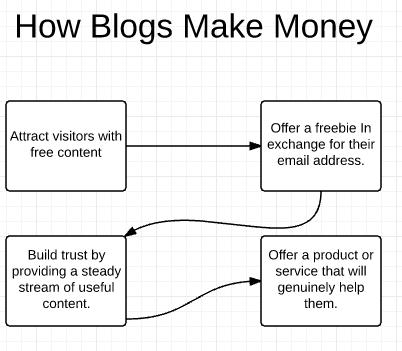
Here’s exactly how to make money from your blog:
  1. Write content that gets lots of traffic
  2. Convert visitors into email subscribers
  3. Send those subscribers content that builds trust
  4. Sell products or services your audience wants
That’s it. Four steps.
The problem?
It’s freaking hard to do. The process is simple on the surface, but each step is enormously complicated and requires extraordinary skill.
Especially the last one.
For instance, do you want to sell your own products or services? If so, which ones?
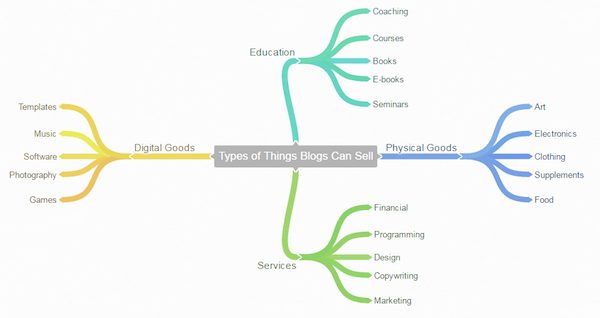
Here are just a few of the options:
Make money blogging by selling these things
Make money blogging by selling these types of things
Or… what if you don’t have any products and services to sell? What should you do then?
Well, you can also make money blogging by selling someone else’s products and services.
The most conventional (and least profitable) method is selling advertising, where you allow companies to promote their products and services to your audience in exchange for a fee. You can also form partnerships with other companies, promoting their products and services as an “affiliate” and earning a commission each time one of your readers purchases.
Which model should you choose? What should you do?
It’s up to you to decide, but before making your decision, there’s one crucial lesson you need to understand:

You’re Not Just a Blogger

The moment you decide to use your blog to make money, you’re no longer just a blogger. At that moment, you also become an entrepreneur, and your blog becomes a small business.
You’ve probably heard of financial planners giving free seminars to attract clients, right?
Well, blogging is a lot like those free seminars. You’re giving away your expertise and knowledge in the hopes of attracting customers and then gaining their trust.
How blogs make money.
In other words, if your goal is to make money, your blog is a lead generation mechanism. It also nurtures those leads until they are ready to purchase.
“But Jon,” you say. “This sounds too corporate. I just want to make a few bucks on the side teaching people what I know.”
My response?
Don’t start a blog. In my opinion, it’s a terrible way to make a few bucks on the side.
For one, there’s the time investment. I’ve never seen anyone learn everything necessary to build a profitable blog in less than three years.
For two, there’s the chance of failure. Your first two or three blogs you start will probably fail because you make a fatal misstep.
In other words, it’s exactly like starting a business. Exactly.
Can you get rich?
Sure, that’s why many people are attracted to entrepreneurship. If you start and grow a successful business, you can make millions or even billions of dollars.
But you can also lose everything.
For every entrepreneur who makes millions, there are dozens who invest years of their life into companies that ultimately fail, sometimes bankrupting them in the process. It’s a high risk/high reward lifestyle, and it requires more skill, smarts, and good old-fashioned work than most people can fathom.
I’m not saying that to discourage you. I’m just trying to make sure you have reasonable expectations.
Let me tell you how it happened for me…

My Journey from $0-$100,000 a Month

It took me about five years to earn my first dollar.
During that time, I started four different blogs, working on them at night and on the weekends. The first three failed. Despite investing hundreds of hours into each one, I made too many mistakes, and I eventually had to shut the blogs down. I didn’t earn a penny from them.
And I won’t lie to you… it sucked.
Each time a blog failed, I seriously thought about quitting. I felt like I was putting in all that time and energy for nothing.
But it wasn’t true. I was learning.
Yes, I made a lot of mistakes, but I didn’t repeat them. So, while those first four blogs were all “failures,” each one was also closer to success than the last.
With the fourth blog, everything finally clicked. I was getting 1000 visitors a day within about two months, and I sold it for $10,000. That’s when I knew I was onto something.
From there, I went to work for other big blogs for a few years, helping grow Copyblogger and KISSmetrics into what they are today. Eventually though, I felt the itch to go out on my own again, so I left and started this blog. It now turns a fairly steady $100,000+ a month.
In total, it took me about eight years to get here, but in exchange for investing those eight years, I now have enough money to support me until the day I die. Also, every day I get emails from people telling me how I changed their lives for the better.
So, it was worth it. No question.
But was it easy?
No. It was just as hard as starting any other business.
I did learn a thing or two that might speed along the process for others, though. Below, I’ve recorded a few of those lessons, and I believe some of them might surprise you…

Lesson #1: Don’t Sell Advertising

Ask your average beginner how they plan to make money blogging, and they’ll say they plan to sell ads on their site. After all, that’s how big newspapers and magazines monetize, so why not them?
But it’s a mistake.
When I was at Copyblogger, we ran a little experiment. Normally, we refused to sell any ads on the site, but just as a test, we decided to put three ad spots in the right sidebar. The site looked like this:
Copyblogger ad placement experiment.
Initially, we placed ads for our own products in each of the three spots, and we tracked all the sales resulting from someone clicking on the ad. I don’t remember the precise numbers, but we had something like $50,000 in product sales over 30 days. Not too shabby.
Well, out of curiosity, I shopped around to see how much advertisers would pay for the same ad space. The absolute highest rates I could negotiate would’ve brought in only $5,000 per month per ad spot, totaling $15,000 per month — 70% less than we made selling our own products.
And this was for a big, authority site! Imagine the pitiful rates a beginning blogger would get.
Granted, it’s not really a fair comparison. With your own products, you have to consider the cost of development, support, and other miscellaneous expenses, but even factoring those in, advertising our products was still more profitable by far.
The next most profitable strategy would have been to partner with other companies, collecting a commission on each sale as an affiliate. We never tested it, but I would guess we would’ve made somewhere around $25,000 per month on the spots — 60% more than advertisers would have paid.
The point?
If you have an engaged audience that trusts you, selling ads is never a smart move. You’re better off either selling your own products or getting a commission from endorsing another company’s products, assuming you truly believe in them, of course.
Sometimes though, you have no choice. If you’re a beginner, chances are you have no product to sell. What should you do then?
Let’s talk about that next…

Lesson #2: Start with Affiliate Marketing (or Services)

As I write this, it just so happens that I’m in the initial stages of starting a new blog (more details to be announced soon). It’s in a completely different space where I have no products, so I’ve been pondering the best way to monetize it, and here’s what I think…
Affiliate marketing is the smartest strategy.
If you’re not familiar with the term, it’s a business model where you endorse other people’s products or services in exchange for a commission. On software and information products, affiliates typically earn a 50% commission or sometimes even more, so it can be quite lucrative.
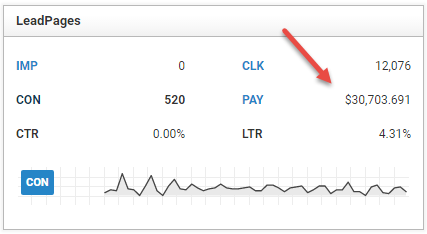
Pat Flynn, for example, makes over $100,000 a month in affiliate commissions. Here at Smart Blogger, we mostly promote our own products, but we also make a tidy sum promoting LeadPages and SiteGround:
Our Lead Pages affiliate commissions.
Granted, you won’t make that kind of money when your blog is small, but affiliate marketing is still a good way to start for several reasons:
  • It’s faster. Instead of investing months or even years creating a product, all you have to do is publish a link on your site. Assuming your audience is engaged, you could be earning commissions within hours or even minutes.
  • The income from affiliate marketing is almost entirely passive. You don’t have to worry about creating products, supporting customers, or any of the technical complexity of selling your own products or services. You can also invest the time you save into growing your traffic, leading to more revenue later.
  • It can guide future product creation. If one affiliate product sells 10X better than all the others you promote, you might want to think about developing your own version of the product, because you have proof your audience wants it.
Personally, I think the advantages are so enormous that no beginning blogger should consider any other business model… with one exception:
Service providers.
If you are a graphic designer, real estate agent, attorney, or any other type of service provider, you probably want to offer your services on your blog from day one. The profit you make will almost certainly outstrip anything else, at least in the beginning.

Lesson #3: Build the Funnel in Reverse

Even if you’re making fantastic money from affiliate marketing or selling services, chances are you’ll want to try your hand at developing your own product at some point. So, where should you start?
My answer: with blogs, the most profitable price is usually the end of the funnel. Here’s what I mean…
Build a sales funnel in reverse.
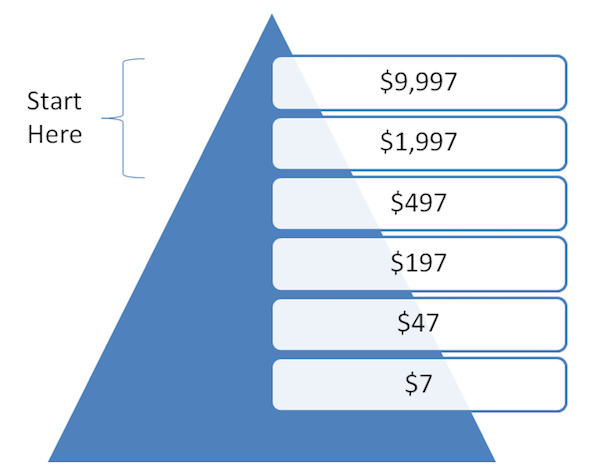
Build a sales funnel in reverse, starting with higher prices.
You’ve seen a sales funnel, right? A company entices you with a freebie, then they offer you something cheap but irresistible, and then they gradually sweet talk you into buying more and more expensive stuff. It’s a tried and true marketing tactic, and you should absolutely build a sales funnel for your blog.
What you might not know is you should build it in reverse.
A lot of bloggers launch a cheap e-book as their first product, and then they get frustrated when they don’t make much money. Here’s why: the real profit is at the end of the funnel, not the beginning.
Selling e-books is fine and dandy if you have half a dozen more expensive products to offer your customer afterwards, but it’s downright silly if you don’t. You’re much better off creating and selling the expensive product first, and then gradually building cheaper and cheaper products.
When you do have some less expensive products to sell, you can offer those to new people first, safe in the knowledge that you have something more profitable up your sleeve to sell them later.
Here at Smart Blogger, our products cost $9,997, $1,997, and $997, $497, $197, and $47.  We started on the expensive side first, and we gradually worked our way down. It’s been much, much more profitable this way.

Lesson #4: There’s No Such Thing As a “Cheap” Market

“But Jon,” I can hear you spluttering. “I can’t sell a $10,000 product! My customers don’t have that much money.”
My response: you’re 98% right. Unless you’re selling exclusively to multimillionaires, the vast majority of your customer base won’t be able to afford premium products, but what’s interesting is it doesn’t matter. Often, you can make more money selling to the 2% than you can to the entire 98% combined.
For instance, our $10,000 product is a year-long coaching program for bloggers — a group that’s not exactly known for their wealth, but I always fill all ten spots within minutes of opening the program. Here’s why: the last time we opened it, I notified 40,000 bloggers. 2% of 40,000 writers is 800 people. By only accepting 10, I’m creating a situation of extreme scarcity.
Sell high end products to the 2%
You can do the same thing, even if your list is much smaller. If you have 100 subscribers, chances are two of them might be willing to buy premium products or services from you, and those two will often pay you more money than the other 98 combined.
And let me be clear…
I’m not saying you have to charge $10,000. We actually make even more money from our $2000 product than we do the $10,000 one:
$266,132 profit from selling our writing course.
The point is, most people are afraid to charge more than $200 for a class, believing that’s all people can afford, but it’s just not true. Every market has customers who are and willing to pay for a premium experience. Give them one.
Just be aware… higher prices demand bigger promises. Let me explain.

Lesson #5: The Price Depends on the Promise

Let’s go back to the example of the $10,000 coaching program. How on earth did I get people to pay me that much money?
It’s not because they were stupid. They didn’t get one of my emails and say, “Oh, look honey, this is a fabulous opportunity to throw our money away. Let’s give this good-looking fellow $10,000 just for the hell of it.”
On the contrary, they expected a lot of me. In exchange for that $10,000, I promised to help them launch their blog from scratch and get their first 10,000 email subscribers in only 12 months.
That’s one hell of a promise. Just to put a dollar value on it, you could probably sell a blog with 10,000 subscribers for at least $100,000 in most markets. So, I was essentially promising them $100,000 of value in exchange for only $10,000.
This, my friend, is one of the fundamentals of business.
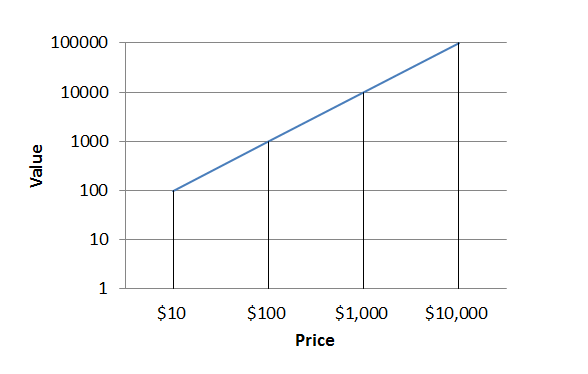
If you want to charge high prices, you absolutely can, but you must make big promises. Similarly, if you want to charge low prices, you absolutely can, but you must make small promises. In either case though, the value of the promise should be at least 10X the price.
The value of the promise should be at least 10X the price.
For instance, we have a guest blogging course that retails for $497. In exchange, we promise to help students get featured on a big blog or magazine like The Huffington Post or Forbes. I think it’s fair to say that exposure is worth $5,000 to the right person. So, the product sells easily and well.
Not to say everything is sunflowers and daffodils here, though. In fact, there are are two easy ways to screw up:
  1. Charging high prices but making small promises (result: the product doesn’t sell well, and you waste a ton of time).
  2. Charging low prices but making big promises (result: lots of customers, but you make no profit).
There’s a rumor floating around that I’ve made each of those mistakes on multiple occasions. Some people also say I have to be repeatedly reminded about the graph above, lest I slip up and nearly bankrupt the company (again).
But come on, who are you going to believe? 😉
No, in all seriousness, I learned all of these lessons the hard way. If you’re wondering how to price your product or service, you’d be wise to heed my words.
Oh, and a few final points before we move on:
  • Needless to say, you should only make promises you can actually fulfill. Anything less is unethical.
  • If people immediately think you’re full of shit upon hearing your promise, then you’re in trouble. In my opinion, this is what marketing is really about: getting people to trust you when you say you can help them. The better you are at it, the more money you’ll make.
  • In the above graph, “value” refers to how much the customer values what you’re promising them, not your own personal value. For instance, I personally think my guacamole is worth $10,000 a bowl, but none of my friends agree with me, so I’m forced to give it to them for free. Bastards.
Also, I’m skipping a lot of other important topics like price testing, competition, and economics, but in my opinion, none of those things are even worth considering until you know the answer to this one simple question:
What can I offer people that’s worth 10X what I charge?
Answer that, and you’ll at least be headed in the right direction.

Lesson #6: Webinars Kick Butt

If you’ve been on our email list for long, you know that we do a lot of webinars. Here’s why:
On average, each webinar generates about $60,000 in sales. It’s by far the most profitable thing I do. Nothing else even comes close.
If you’re wondering how on earth we make that much money, part of it is how many people attend. For instance, here’s a webinar where we had over 3,000 people registered to attend:
We've had 3650 registrants for our webinars.
But that’s only part of it.
The other part is just the skill of doing a really good webinar. If you want to know how we do it, all you have to do is attend one of our webinars to find out. Everything we do is on display, and you can study it, free of charge.

Lesson #7: Automated Funnels Are Even Better

You know what works even better than webinars for us?
Automated funnels. Take a look at this bad boy:
Use automated funnels to make more money.
Now, before I get into the nitty-gritty details, a word of warning: this is extremely advanced marketing. I don’t even recommend you think about this until you cross $100,000 per year in revenue.
But here’s the idea:
Through the magic of technology, we have sales happening every minute of every day. We can automate who gets discounts at what times, as well as when those discounts expire.
We can also chain together promotions. If you don’t respond to a $2000 offer, we might follow up with a $497 offer, which now seems cheap by comparison.
Oh, and did I mention we are tracking your every move?
For instance, you’re reading a post about how to make money blogging. If you’re a subscriber, what do you think the odds are that you’ll receive an email from us sometime soon offering you a product about how to make money blogging?
Hmm. Pretty good, I think. 😉
And just to be clear, this is all automated. I’m not doing anything. No one is.
The computer is following rules we set up in advance, and it’s following them 24 hours a day, seven days a week, 365 days a year.
Welcome to the future of marketing.

Lesson #8: Your Email List Is More Important Than Anything Else

Okay, enough flashy technology. Let’s get back to foundational principles.
In analytics, there is a principle called “the one metric that matters” (OMTM). The idea is that you find a single number that accurately predicts the success or failure of your project.
In the case of blogging, that number is the size of your email list. (Not RSS, mind you — it’s dying a slow but certain death.) In my experience, your email list is the most accurate predictor of how much money you’ll make.
We have 217,229 people on our mailing list.
Here at Smart Blogger, we strive for one dollar per subscriber per month in sales, and I think that’s a good place to start when you’re a beginner too. In other words, an email list of 1,000 subscribers should result in at least $1,000 per month in sales, 10,000 subscribers would result in $10,000 per month in sales, and so on.
The more subscribers you get, the more money you make. Granted, your relationship with your subscribers and the quality of your products or services and dozens of other factors still matter, but to drive revenue, focus on email list growth. To make money blogging, it’s absolutely essential.
Find out how much money your blog could be makin

Lesson #9: Start Selling from Day One

How long should you wait before you begin selling? 1,000 subscribers? 10,000 subscribers? More?
Nope. Start selling from day one. Here’s why:
Motivation.
If you’re not making any money from your blog, it’s hard to stay motivated to continue. The opposite is also true. For instance, how do you think I feel when I see this number pop up on my dashboard every day?
We've made $579,905 from blogging so far this year.
It’s pretty easy to feel pumped with numbers like that. 🙂
And honestly, the numbers don’t have to be big.
I remember the first morning I woke to discover I’d made $100 overnight. It felt… magical. It also gave me the motivation to do the work necessary to make sure that happened every night.
It’ll be the same for you. When you have money being deposited into your account every day, it’s a whole lot easier to keep yourself motivated.
It will also give you the funds you need to build a team around you. You can hire an assistant, a tech person, a billing person. The faster you get rid of stuff you suck at doing, the faster you will grow.
Now, a caveat: don’t turn your blog into a gigantic sales pitch. Nobody likes that. You should, however, be offering something your audience wants and needs. Don’t push them on it, but do make it available, and do remind them from time to time that they can purchase it.

Lesson #10: Share What You Learned

Now, we come to the reason for this post.
Why on earth would the CEO of the company (me) work hours to write a post like this, sharing all our secrets? It’s nearly 4,000 words, for God sakes!
Simple:
It’s my responsibility. If people are ever going to respect blogging as a legitimate business model, those of us who are successful have to speak up and share what we’ve learned. None of us works in a vacuum. The only way we can advance our field as a whole is to collectively share what we’ve learned.
After all, isn’t that what we’re here to do? Help people?
In the end, that’s what I love most about blogging: every article we publish, every course we create, every coaching call we do can change somebody’s life. Maybe not always in a big way, but we touch thousands upon thousands of people, and we make their lives just a little bit better. We inform them, we inspire them, and we give them the roadmap for achieving their dreams.

WHAT ARE YOU WAITING FOR, MMM IS REAL

MMM Nigeria announces a new promo. Every person who will register in MMM in the period from September 26 up to October 30 will be awarded 1000 Mavro-Naira as a gift. No need even to provide help to receive this gift: a person just needs to sign up in the Community during this period and add his/her bank account details in the Personal Office. After a while the amount of 1000 Mavro-NGN will be automatically awarded to his/her PO account.
The purpose of the offer is to give each registered person an opportunity to get help from another MMM member instantly after registration, and make sure that MMM works and people really help each other here.
Dear members! Use this promo and invite all your friends, acquaintances, colleagues, who are not MMM members yet, to join our Community!
When you invite people to join the Community, don''t forget to tell them about MMM ideology. The goal of MMM is NOT to assist anyone to get richer quickly. MMM creates a platform through which people help each other directly. And finally, with MMM people can build a society with no segregation: where all people will have equal opportunities, regardless of where they live, what their status is, and who their relatives or their friends are! Register here and start making money immediately.